Pipeboard vs Adspirer: Meta Ads MCP Compared (2026)
Adspirer Team
Pipeboard is the most actively-maintained Meta-only MCP in the ecosystem. Adspirer is a unified MCP covering Meta plus three more platforms. On Meta-only workflows the fight is close. Across a multi-platform stack, the question stops being “which is better” and becomes “do I want one MCP or three from the same vendor.”
If you’re evaluating MCP servers for Meta Ads in 2026, Pipeboard is almost certainly on your shortlist. And it should be — 791 GitHub stars, 133 releases, paused-by-default campaign creation, a real company behind it. It’s the most mature Meta-specific MCP in the ecosystem, and we respect it.
We also compete with it. This post is our honest head-to-head — where Pipeboard wins, where Adspirer wins, and why the answer depends heavily on whether Meta is your only platform or one of several.
Full disclosure: Adspirer is our product. Where Pipeboard is better, we’ll say so. We wrote this for buyers who are legitimately comparing us — not as a takedown.
The One-Screen Answer
| Factor | Pipeboard | Adspirer |
|---|---|---|
| Platform coverage | Meta (+ separate Pipeboard Google and TikTok MCPs) | Google, Meta, LinkedIn, TikTok — one server |
| Meta depth | Very high — campaign creation, ad sets, ads, creatives, budgets, targeting | High — campaign creation, budgets, targeting, creatives, audience research |
| Read/Write | Full R/W, paused-by-default | Full R/W, paused-by-default + structural safety rails |
| Hosting | Remote SaaS (recommended) or self-host OSS | Remote SaaS only |
| Licensing | Business Source License 1.1 (→ Apache 2.0 in 2029) | Commercial |
| Pricing | Free tier + paid tiers | Free (15 calls/mo) → $49 / $99 / $199 |
| AI client coverage | Claude Desktop + MCP-compatible clients | 12 AI clients documented, incl. ChatGPT Connectors, Cursor, Codex, Claude Code, OpenClaw, Gemini CLI, Manus |
| Multi-platform reasoning | Cross-namespace across 3 MCPs | Single tool namespace |
| Support | Community + commercial (paid tiers) | Commercial on all paid plans, 24hr SLA on Max |
If Meta is 80%+ of your spend and you’re comfortable with per-platform MCPs, Pipeboard is a legitimate pick. If you run two or more platforms — especially if LinkedIn is one of them — Adspirer is the closer match.
Now the nuance.
What Pipeboard Is, Accurately
Pipeboard is a Meta Ads MCP server built by a small commercial company. The repo (pipeboard-co/meta-ads-mcp) has 791 stars, 489 commits on main, and 133 releases as of April 2026. Licensed under Business Source License 1.1, which converts to Apache 2.0 on January 1, 2029 — a nice piece of license design that gives long-term OSS confidence.
The Meta MCP supports:
- Campaign, ad set, and ad creation
- Creative uploads and updates
- Budget scheduling and modifications
- Targeting configuration
- Ad status and bid modifications
- Performance analytics and reporting
Campaigns are created paused by default. All changes require explicit confirmation. This is a well-built product.
Pipeboard also ships separate MCPs for Google Ads and TikTok Ads at different URLs. Those aren’t included in the Meta MCP — they’re three different products from the same company, each installed and configured independently.
What Adspirer Is, Accurately
Adspirer is a unified remote MCP server covering Google Ads, Meta Ads, Amazon Ads, ChatGPT Ads, LinkedIn Ads, and TikTok Ads behind a single authentication and configuration. 400+ tools across all six platforms.
Meta-specific capabilities include:
- Campaign, ad set, and ad creation (Search, Image, Video, Carousel, Sponsored Content)
- Budget and targeting configuration
- Audience research and lookalike analysis
- Creative fatigue detection
- Placement optimization (Feed vs Stories vs Reels)
- Cross-platform performance comparison — including vs. Google, LinkedIn, TikTok
All new campaigns are created paused. The tool layer hard-gates destructive actions in a way most MCPs don’t: delete_*/remove_* tools won’t run unless the call explicitly passes confirm_delete: true, so “pause” can never be misrouted into a deletion. Reversible changes like pausing or adjusting budgets are supported but staged for your approval. These are architectural guardrails, not prompt-based ones.
For the full capability list, see the Adspirer capabilities doc.
Where Pipeboard Beats Us
Let’s start there, because it matters.
Meta depth and release velocity
Pipeboard’s Meta MCP ships releases more frequently than we ship Meta-specific updates. 133 releases for a single-platform MCP is extraordinary. If your primary concern is “who’s going to have every Meta API surface wrapped the fastest,” Pipeboard’s answer is hard to beat.
Open-source transparency
Pipeboard’s code is public under BSL, converting to Apache in 2029. You can read exactly what the server does with your Meta credentials. Adspirer is a commercial closed-source service — that’s a deliberate choice, but it’s a real trade-off for buyers who value source-level auditability.
Self-host option for privacy-sensitive workloads
You can run Pipeboard’s Meta MCP in your own infrastructure. Some regulated or privacy-sensitive teams will insist on this. Adspirer offers private deployment under Enterprise, but there’s no free self-host path.
Pure Meta-specific tooling count
Pipeboard has tools we don’t have, because they’ve had longer and focused attention on Meta. If you find yourself wanting to twist an unusual Meta parameter — boosted post specifics, Instagram-only placements, niche pixel event configurations — Pipeboard may already expose a tool for it. We cover the workflows 95% of Meta advertisers actually run; Pipeboard covers a wider surface of the API.
Where Adspirer Beats Pipeboard
Four platforms under one OAuth
This is the big one, and it applies the moment you run more than Meta. If your stack is Meta + Google + LinkedIn + TikTok, Pipeboard’s answer is “install three of our MCPs, and find a community MCP for LinkedIn because we don’t cover it.” Adspirer’s answer is “one config.”
Four OAuth flows versus one. Three remote service URLs versus one. Three tool namespaces the LLM has to reconcile versus one.
For single-platform Meta users this doesn’t matter. For everyone else it’s decisive.
LinkedIn coverage
Pipeboard has no LinkedIn Ads MCP. Adspirer does — 28 tools, full write, LinkedIn docs here. For B2B advertisers this is a hard requirement, not a nice-to-have. Pipeboard would need to refer you to a community MCP like DanielPopaMD’s or stand up your own integration.
AI-client coverage beyond Claude Desktop
Pipeboard documents Claude Desktop, Claude Code, Cursor, ChatGPT, and MCP-compatible clients. Adspirer documents all of those plus Claude Cowork, Codex, Windsurf, OpenClaw, Gemini CLI, Manus, Perplexity, and Custom GPTs — and provides purpose-built agent skills for Claude Code, Cursor, Codex, and OpenClaw rather than generic MCP tool use.
If your team is on any of those clients, Pipeboard is going to feel like a Claude Desktop-first product in ways Adspirer doesn’t.
Structural safety rails
Both tools create campaigns paused by default. Only Adspirer structurally refuses the destructive operations — the tool layer doesn’t expose delete/pause/budget-modify tools for existing campaigns. This is an architectural difference. A destructive tool that asks for confirmation still runs if confirmed; a destructive tool that doesn’t exist can’t be invoked.
For agency workflows where multiple team members might trust the AI with different levels of oversight, this matters.
Multi-account and multi-client routing
Adspirer is explicitly designed for agency workflows — multiple client ad accounts across multiple platforms inside a single conversation, without swapping configs. See multi-account and multi-client. Pipeboard supports multiple Meta accounts; routing across Meta + Google + TikTok requires context-switching across three MCPs.
Cross-platform reasoning in one turn
Ask an LLM “what’s my blended CPA across Meta and Google this week?” On Adspirer, that’s one tool namespace and one reasoning pass. On a Pipeboard stack, that’s two MCPs, two tool namespaces, two result formats for the LLM to reconcile. In our testing, LLMs make more reconciliation errors across namespaces than within them. Ymmv, but the architectural difference is real.
The Meta-Only Showdown
If Meta is genuinely your only platform and will stay that way, the decision narrows to: pick between two well-built Meta MCPs.
Both are real products that solve real problems. The buyers for each are different.
The Multi-Platform Showdown
This is where the comparison stops being symmetric.
If you run Meta + Google
Pipeboard ships two separate MCPs for this. You install both, configure both, authenticate both, maintain both. When Meta ships an API change, Pipeboard updates the Meta MCP. When Google deprecates an Ads API version, Pipeboard updates the Google MCP. Same company, two products, two maintenance paths.
Adspirer ships one server. Cross-platform queries happen in one tool namespace. When either platform ships a change, the update is server-side and invisible to your config.
Operationally, this is a meaningful difference. The more platforms, the more it matters.
If you run Meta + Google + TikTok
Pipeboard covers all three — but as three separate remote services. You’re running three installs. Your LLM sees three tool namespaces and has to pick the right one for each query.
Adspirer is one server with 400+ tools across all six platforms it covers.
If you run Meta + Google + TikTok + LinkedIn
Pipeboard doesn’t cover LinkedIn. You’d pair three Pipeboard MCPs with a fourth community MCP (DanielPopaMD’s, typically). That’s four tools from two-plus vendors, and the LinkedIn MCP is community-maintained.
Adspirer covers all six.
This is where the “unified” claim stops being marketing and becomes a real operational advantage.
If you’re an agency managing 20+ client accounts
Routing between twenty Meta accounts across three Pipeboard MCPs plus a LinkedIn community MCP plus a TikTok community MCP is technically possible. It’s also a maintenance surface that will eat hours every month.
Adspirer’s multi-account and multi-client routing is the explicit design target. See our agency automation guide.
Pricing Compared Honestly
Both companies publish pricing; both have free tiers.
| Tier | Pipeboard (approximate) | Adspirer |
|---|---|---|
| Free | Free tier on Meta MCP | 15 tool calls/mo forever, all 4 platforms |
| Entry paid | Paid tier available | $49/mo (150 calls/mo) |
| Mid paid | Higher tier available | $99/mo (600 calls/mo) |
| Top paid | Enterprise | $199/mo (3,000 calls/mo, 24hr SLA) |
Pipeboard’s per-platform model means multi-platform buyers are paying for three subscriptions (or three free tiers with their own limits). Adspirer’s four-platform coverage is priced once.
If you only need Meta: Pipeboard’s free tier is hard to beat. Adspirer’s free tier is also real. Both are credible starting points.
If you need Meta + anything else: compare the total cost of ownership, not just the sticker price. Three Pipeboard subscriptions plus community MCP maintenance time is the real alternative to one Adspirer subscription.
See Adspirer pricing for plan details.
Safety: Where We Explicitly Differ
Both tools use paused-by-default for new campaigns. That’s table stakes and we’re glad Pipeboard does it too.
Adspirer goes further with structural refusal of destructive operations on existing campaigns. Specifically:
| Destructive operation | Pipeboard | Adspirer |
|---|---|---|
| Delete existing campaign | Available (with confirmation) | Hard-gated behind confirm_delete |
| Pause running campaign | Available (with confirmation) | Available — staged for your approval |
| Modify existing budget | Available (with confirmation) | Available — staged for your approval |
Why this matters: confirmation-based safety works as long as the person reading the confirmation is paying attention. In a chat-driven workflow with dozens of tool calls per session, “click confirm to proceed” becomes muscle memory. We’ve seen it happen. Structural unavailability is a different guarantee — the LLM can’t call what doesn’t exist.
This isn’t a claim Pipeboard is unsafe. It’s a claim that the two products have different safety philosophies: Pipeboard trusts the user to read every confirmation; Adspirer removes the most dangerous operations from the tool surface entirely. Pick based on your team’s tolerance and oversight model.
Full detail in our security docs.
Migration and Co-Existence
A question we get often: “can I use both?”
Technically yes — MCP clients can have multiple MCP servers configured. Some teams legitimately do this: Pipeboard for a specific Meta workflow, Adspirer for everything else. The LLM will happily pick which MCP to call based on the query.
In practice, we see most teams consolidate over time. Running two MCPs that both do Meta creates ambiguity — the LLM sometimes picks the wrong one, and you end up adjusting prompts to disambiguate. Most teams either stay on Pipeboard (for Meta-heavy workloads) or consolidate on Adspirer (for multi-platform workloads).
If you’re migrating from Pipeboard to Adspirer, the process is:
Connect your Meta account to Adspirer
One OAuth flow. Takes under a minute. See the Meta Ads setup guide.
Connect any additional platforms you want to add
Google, LinkedIn, TikTok — each is a separate OAuth, but all live under one Adspirer account.
Update your AI client config
Point to the Adspirer MCP endpoint. See AI client setup guides.
Remove or leave Pipeboard configured
If you’re consolidating, remove Pipeboard from the client config. If you’re running both, leave it and see which gets used.
No data migration — everything lives in your Meta account, not in either MCP.
When Each Is Definitely the Right Pick
Real answers for real situations.
Pick Pipeboard if:
- Meta is your only platform and will stay that way for at least the next year.
- You want the deepest Meta API coverage available in any MCP.
- You need self-hosting (privacy, compliance, or preference).
- Open-source / BSL-to-Apache licensing matters to you architecturally.
- Claude Desktop is your primary (or only) AI client.
Pick Adspirer if:
- You run two or more platforms — especially if LinkedIn is one of them.
- Your team uses multiple AI clients (ChatGPT, Cursor, Codex, Claude Code, OpenClaw).
- You want structural safety rails, not just confirmation-based safety.
- You value commercial support with SLA over community support.
- You’re an agency managing multiple client accounts across platforms.
Run both if:
- You have a specific deep Meta workflow Pipeboard handles better, and everything else lives in Adspirer. This is fine. Configure both in your client and direct the LLM as needed.
FAQ
Conclusion
Pipeboard is a good product. We say that sincerely — they built the best single-platform Meta MCP in the ecosystem, they ship releases faster than most companies document theirs, and the BSL-to-Apache licensing is a genuinely nice piece of work.
Our pitch isn’t that we’re better at Meta. It’s that the unified four-platform surface — with one OAuth, one tool namespace, structural safety rails, and first-class coverage across twelve AI clients — is the right shape for most buyers asking this comparison question. If you run Meta only, Pipeboard’s free tier is a sensible starting point. If you’re on more than Meta, or you expect to be, Adspirer is what we built for that case.
Try Adspirer free. 15 tool calls/month, no credit card, Meta + Google + LinkedIn + TikTok under one account. See how unified actually feels. Get started free →
Related Articles
- The 10 Best Ad MCP Servers in 2026 — Honest Rankings
- Why You Shouldn’t Just Use Google’s Free MCP Server
- What Is MCP? A Marketer’s Guide
- 10 Best AI Tools for PPC Managers in 2026
- Connect ChatGPT to Meta Ads
- Build an AI Marketing Agent for Paid Media
Docs cross-references:
More articles to read

Claude Code for Google & Meta Ads: Agent Setup (2026)
Use Claude Code for Google Ads and Meta Ads: install the Adspirer plugin, use a terminal workflow, set guardrails, audit, and build paused campaigns.
![How to Run Facebook & Instagram Ads with Your Codex AI Agent [2026]](/blog/_astro/hero-meta-ads-codex-agent.D8z_HDR0_Z1fdifA.webp)
How to Run Facebook & Instagram Ads with Your Codex AI Agent [2026]
Build a Meta Ads specialist agent with Codex: creative fatigue monitoring, audience optimization, campaign ideation from real data, and autonomous workflows that compound knowledge.
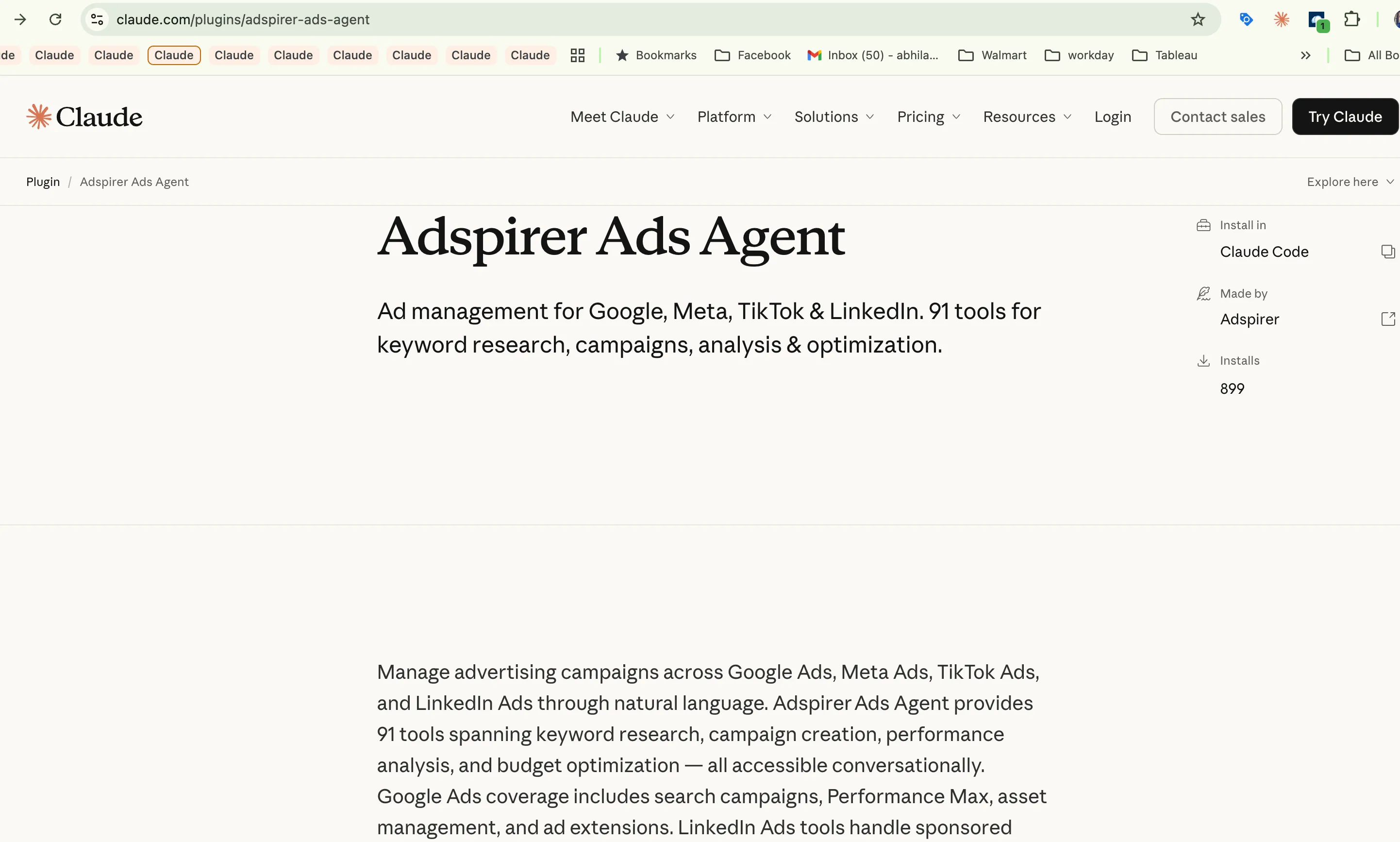
Adspirer Is Now an Official Claude Code Plugin
Adspirer is now available in the Claude Code official plugin marketplace. Install with one command and manage Google, Meta, LinkedIn, and TikTok Ads from Claude.
AdKit vs Adspirer: Which AI Ad Tool Goes Deeper? (2026)
AdKit vs Adspirer in 2026 — AdKit focuses on ad research and creative; Adspirer runs and optimizes campaigns across six platforms with deep analytics, monitoring, an Ad Ops agent, and dashboards. Coverage, capabilities, pricing, and how to choose.